Shoulder - Elbow - Hand
By Richard Sinnerton - Everything you need to know about the upper limb and were afraid to ask

Operations
Our Services

ACJ (Hook Plate, Surgilig)
I am going to talk about the various ways of treating an ACJ dislocation – surgery for an arthritic ACJ is discussed in the ‘surgery for tendonitis’ section. So, you are one of the unfortunate ones who has an ACJ dislocation that requires surgical stabilization – either because it is an acute grade 5 or a lower grade that is causing problems a few months down the line. Remember what we are trying to do is get those torn ligaments next to each other so that they can scar up and heal with the ACJ lined up as it should be. The operation I do depends on whether your’s is an acute injury (operation possible within 2-3 weeks) or chronic (anytime longer than that). In the acute case I just use the Hook Plate and in the chorionic cases that is augmented with an artificial ligament. Acute Cases using Hook Plate What does that entail? The surgery is done as a day-case, under a general anaesthetic and through an 8 cm (or so) scar running lengthways along the end of the clavicle and across the damaged ACJ. I clear away any tissue that may have got caught in the joint and which would prevent the two bones lining up properly and make sure they do line up in the right place. Then I insert a Hook Plate. This is a metal plate with a hook on the end. The hook goes under the acromion and when I push down on the plate end this reduces the ACJ back into alignment and I can attach the plate to the clavicle with screws. By reducing the ACJ back to its original alignment, the torn ends of those ligaments come together and can heal up. That sounds a bit barbaric – isn’t there a keyhole way to do this? There are lots of ways to do this – including a keyhole method – but, in my experience, they don’t work as well as the Hook Plate because they simply aren’t strong enough to hold the weight of the arm in place while those ligaments heal. So that is what I use. Does that plate stay in? No. It has to come out. That is very important. Usually it comes out after about 4 months. What is the recovery like after this operation? Can I use my arm? Can I play sports? You have to be in a sling for 2 weeks (it’s the same with any operation to stabilise the ACJ) so you can’t drive or do physical work. You can move the elbow and use your hand so you aren’t rigidly tied down. The purpose of the sling is to stop you trying to use the arm up in front of you. Once you come out of the sling then you start therapy to get the shoulder moving again and build up your activities week by week. Will I get full movement back? Yes you will but probably not until I take the plate out. Most people find that they don’t get full movement before the second operation but that last bit returns very quickly afterwards. So you will be able to do some sports and activities between the surgeries but not all. And will it be a normal shoulder after that? It should be as good as new so you can get back to full activity and do everything you want to do with it. The aim is to get movement back first and then build up your strength. Physiotherapy is very important and swimming (or exercises in the water) is a great way to rehabilitate. Usually the recovery is very quick after the plate comes out – maybe 6 weeks – but remember the plate stays in for about 3 – 4 months after the first operation. So overall it will be 4 – 5 months before you are really back to normal. Chronic Cases using the Hook Plate + Infinity Loop You said after 3 weeks I’d missed the Hook Plate option? I damaged my ACJ 6 months ago, was told it would heal but it is still mobile and painful. So how do you deal with that? Thankfully there is an excellent option in the chronic case. So we haven’t blown your chances of a great shoulder if we made the wrong decision early on believing that it was going to go on getting better. At this stage the ends of the torn ligaments won’t heal together because they have scarred up while they were separated. So even if they are brought together with a Hook Plate they won’t bond up. In this situation I have to add an artificial ligament that will hold the clavicle back onto the scapula with the ACJ lined up permanently and I use something called the Infinity Loop. This ligament provides the long-term, permanent fixation of the ACJ in its proper alignment but I also put in a Hook Plate to keep everything stable for the first few months while the ligament bonds to the bone and the bodys natural tissues start to incorporate into the articial ligament. The Hook Plate not only limits the up and down movement but also the forward and backward movement at the ACJ while everything beds in. Click on the link below to see a video of the Infinity Loop being inserted. http://Https://vimeo.com/147848856 The plate does need to be taken out after 4 months so a second procedure is required but that is a quick job and doesn’t really slow things up. You will be in a sling for 2 weeks after the surgery and then you start to mobilise guided by the physios. I don’t expect you to have regainied full movement before the plate comes out – although a few do – but any residual stiffness does come back very quickly after the plate has been removed.

Dislocation (Bankart, Latarjet, TCS)
Operation for a Dislocated Shoulder You are young, sporty, have dislocated your shoulder and after discussing the options you have decided to go for the surgery now in order to get back to full activities as soon as possible. Or this is your second or third dislocation and you know its only going to happen again so its time for surgery. Or the shoulder has only dislocated once but hasn’t really settled as we’d hoped and feels wobbly and painful and you haven’t been able to get back to your normal activities. So lets discuss your operation. What are you going to do? In most traumatic dislocations what has happened is that the labrum (the lip of cartilage running round the edge of the socket) has been torn off when the ball was forced out of the socket and hasn’t reattached itself. So I will put it back where it came from and fix it back in place. Is this a key-hole operation or through a big scar? It is an arthroscopic or keyhole operation which means it is done through 3 small holes – 2 at the front and 1 at the back. Sometimes though, if I know that the labrum has been too badly damaged – perhaps because you have had lots of dislocations – then I do a different operation through an incision in the front of the shoulder but we will come to that later. And is it a general anaesthetic because I’d rather have a regional if possible? As with all shoulder operations, I much prefer to use a general anesthetic. It is more comfortable and less stressful for you; it allows the anaesthetist to control your blood pressure which can go up quite a lot if you get anxious and then the bleeding obscures my view and it means you won’t move around at vital moments! A modern general anaesthetic usually means that you wake up quickly and with no feeling of sickness and are ready to go home a few hours after the surgery. Do I get that dead-arm thing? The Interscalene Block? Yes you do. This is a special injection that the anaesthetist gives you which makes your whole arm go numb and therefore there is no pain in the shoulder when you wake up and that can last up to 20 hours or so. It is a bit of a strange sensation (I am told – I haven’t had it done!) but it’s much better than being in pain. Most people who have experienced shoulder surgery with the block and without the block would chose to have it again. How do you reattach the labrum? (see video Labral Repair) The first stage is to pass a loop of suture through the labrum which will become the stitch that pulls it down back onto the bone. Once I have that in position then I drill a hole in the bone on the edge of the socket. The ends of the sutures are then fed through an eyelet in a ‘suture anchor’ and the anchor is pushed into that hole. A suture anchor is a bit like a rawlplug – it provides a solid fixation in the bone that the sutures can be attached to. The suture loop is tensioned so that the labrum gets pulled back to the edge of the socket – where it came off when the shoulder dislocated – and the anchor is hammered down into the hole pulling the suture with it and cinching it down very tightly on the labrum. I do the same thing 2 or 3 times along the socket depending on the size of the labral tear. What if the labrum is too damaged to fix back? (see photos Latarjet Procedure) Excellent question! Sometimes that is the case and because the shoulder has dislocated multiple times the labrum has been shredded or has completely eroded away so there isn’t anything to reattach. But don’t worry there is a different and equally good procedure I can do to stabilise your shoulder. I also do it in the occasional case where the bone on the front of the socket has been damaged, eroded away or broken off. This is called a Latarjet Procedure and is done through an 8 cm (or so) incision in the front of the shoulder. We know that your shoulder dislocates when it comes up into the ‘apprehension’ position (the throwing position). So what I need to do is put some sort of seat-belt across the shoulder that tightens up in that position and holds the ball on the socket. And thankfully there just happens to be a spare tendon at the front of the shoulder that I can divert to do that job. The tendon is attached to a prong of bone coming off the shoulder blade. I saw off about 1.5 cm of the prong with the tendon attached and move it out sideways and screw it to the front of the socket. Now when the arm comes up and out that tendon acts as a tight sling across the front of the shoulder and holds the ball in place. The rehabilitation is exactly the same as for the labral repair. Are there stitches in those skin incisions? There are. The stitches come out about 10 days after the surgery. And a sling? Yes. The shoulder has to be held quite still (not rigidly still) while the labrum rebonds back onto the bone. The sling is mainly to stop you lifting your arm up and outwards (as if you were going to throw something) because that is the position which puts the most stress on the repaired labrum. Can I do much in the sling? For the first 2 weeks there is also a body strap that holds the arm across your tummy and you only come out of that to shower. Yes – you do wear the sling at night! However, if you are sensible, then when you are safe and sound at home and sitting watching TV, you can take the whole sling off and rest the forearm on a cushion on your lap. This helps take some of the tension off your neck and back. But before you get up – put the sling back on!! After 2 weeks you can get rid of the body-strap and start to use the arm (still in the sling) gently and carefully in front of you – using a keyboard, holding a book – that sort of thing. How long am I in the sling in total. 4 weeks. And then you can either go cold turkey and get rid of it completely straight away or, more usually, spend the next 2 weeks weaning yourself out of it. It can be a bit much to go from the security of the sling to nothing in one step so most people will spend longer and longer periods out of it and less and less time in it so that by the 6 week mark they are completely rid of it. When can I drive? You can’t drive while you are in the sling. And once you come out of it you need to be sensible and only drive when you are confident that you can control the vehicle. That is usually at least 6 weeks after the operation. I suppose I need physiotherapy? That is essential. You need to get over what I have done to you and also, now the shoulder is stable, you need to get rid of all the bad habits that you will have developed over the months or years when your shoulder has been wonky. The steps you go through are to recover movement, control of that movement and, finally, strength. In that order. I know there is a great temptation to start building your strength back up but there is no point in having a strong shoulder if it doesn’t move! And there is no point in having full movement if it is badly controlled with all sorts of bad patterns and wobbles. So, listen to your physiotherapist and do your exercises regularly. They will usually see you weekly starting after 4 weeks and that will continue until you are back to normal. How long is that? What are the timescales for work and sports? Well returning to work depends on what you do and how you get there. If you are an office worker then you may be able to do a lot from home on the laptop and if you don’t have to drive to work you can go back as soon as you like. But this is a big operation so don’t rush things! You will feel tired and the shoulder can be uncomfortable so try and wangle 2 weeks off if you can. The more physical your job then the longer it’s going to take and for painting and decorating; plumbing; electrics; driving/loading etc it will be 8 weeks before you will be much good and out to 12 before you are back to normal. And sports? How can I keep fit until I can use the arm again? The best, and really only way, is to use an exercise bike and the best of those is the recumbent type where you pedal with your legs out in front of you. You can start running at about 6 weeks but just go a little way and build up slowly. That 6 week mark also holds good for things like swinging a golf club or a tennis or squash racquet – if its your non-dominant shoulder – and a bit longer for your dominant arm. But it is just a starting point and don’t expect to be back to normal straight away. For rugby it is usually 4 months to start running drills and working on the tackle bags and 5 months for full impact. OK – so take things slowly and build up bit by bit? That’s the key. I know you will be desperate to get back to all the things you’ve had to give up but the key element is doing the rehabilitation to get good movement, good control and proper deep-seated strength back in the joint first and you have to sacrifice the sports bit for a while in order to get the maximum result from the surgery. I was really wary about using my shoulder over head height before the operation. Will that recover? Will I get my confidence back? That is a very important point. If you have only had one dislocation then you won’t have lost confidence in the shoulder or developed any bad habits in the way you use it and your brain won’t put up barriers to you using it. On the other hand if you have had lots of dislocations then you are right – your confidence will be shot and you will be scared of putting the arm in some positions because you known it may pop out. With the operation I can deal with the hardware problem and give you a stable joint but that can be the easy part. When you come out of the sling and start moving the shoulder, your brain will still think that is going to dislocate so will still try and prevent you getting into what it sees as dangerous positions. But don’t worry because as time passes and as you do more with the shoulder and perhaps inadvertently let it get into a dodgy position and the shoulder stays in joint, the brain will realise that it is now okay to be in that position and drop that barrier. Can my shoulder dislocate again? I’m afraid so. The operation doesn’t give you a super shoulder but just a ‘normal’ one. So if you do something that would dislocate a normal shoulder it could dislocate the one that has been operated on. If you have torn the labrum off and it is still in reasonable condition then I can do the same keyhole procedure again. If it is too tattered then I will do a Latarjet. So should I be careful afterwards? That is up to you. But remember you are going through a lot in terms of surgery and rehabilitation to give yourself a normal shoulder and the end result should be that you can then do what you want with it. If you damaged it doing something you love you will want to get back to doing that again. So there are no ‘don’ts’.

Shoulder Replacement
You are completely fed-up with the pain and loss of function in your bad shoulder; you can’t sleep and you can’t do the things you want to do; the painkillers aren’t doing the job and you have had enough. So now maybe the time to consider a new shoulder. This sounds like quite a big job though? You are right – it is. But after we have been through all the pros and cons, it usually becomes a fairly straight-forward decision to take the hit now so that in 6 months or so you will be back doing all those things you can’t now. How long am I in hospital? It depends a bit on your personal circumstances and general health. If you have good support at home and have no other medical or physical problems then you probably only need to be in for one night. That allows us to make sure your pain is under control and that there are no immediate complications. If you are by yourself or a little bit less active then we will keep you in for 3 or 4 nights so we are happy you can manage. I am by myself and I don’t think I can cope with being in a sling for a month but I do need this operation. Now is the time to mobilize family, friends and social support from your GP because you are right, it will be very difficult all by yourself. But if you can organize someone to come in twice a day to help with dressing and washing and generally help around the home, then you should be fine. You will need help to some extent for about 6 weeks. How long does the operation take and do I need a general anaesthetic? The procedure takes about an hour and we do it under a combination of a general aneasthetic – which allows us to control your blood pressure and stops you moving about when I am doing the tricky bits – and an Interscalene Block – which gives you a pain-free arm for 20 hours or so. So you should be pain-free when you wake up. Is there a big scar and what about stitches? The scar is about 12 cms long down the front of the shoulder and it will fade to a faint line that will be visible but not obvious. I usually close the wound with metal clips that are removed after 10 days. So what do you do? Not sure I really want to know the details but I suppose I should! It is a good idea to know the details of what is being done to your body but I appreciate not everyone wants to know the gory details! So feel free to skip this bit. (see shoulder replacement video) I need to get down to the worn-out shoulder joint and I approach it through the front of the shoulder. I have to divide one major tendon (subscapularis) in order to get that access so that is the first step. Once that has been released and moved out of the way I am looking at your grotty shoulder joint. Then I release the scar tissue that has built up and tightened the shoulder so that I can dislocate the ball from the socket and pop it out. The next stage is to measure what size your humeral head is using a special guide and then I saw off the worn out humeral head using a jig to get the angle right. If there are any obvious osteophytes (sticky-out bony bits of arthritis) on the socket then I trim those back. Now I prepare the cut surface of the humeral neck to accept the base onto which the new humeral head will be attached. And when that has been hammered solidly into place I am ready to put on the humeral head. Note that I don’t use bone cement to glue things into place because that is a potential weak spot that can crack and fail and allow the implant to loosen. Instead the new shoulder has a coating on it that encourages the natural bone to grow onto and bond with the metal. The new ball is pressed onto the base and I check that it is a good fit and an accurate match to your shoulder. The new ball is then popped back onto the socket to recreate the ball and socket joint and I check that it all moves smoothly. And then I finish off by reattaching the tendon I cut at the beginning and close everything up, put on the dressings and a sling. You go to the recovery bay until you are wide awake and then back up to your room. That is the carpentry bit over and soon the hard work will start! You mentioned a sling. How long am I in that and how much can I move my arm? You are in the sling day and night for 4 weeks but coming out daily to do some gentle exercises. Then you spend the next 2 weeks weaning yourself out of the sling i.e. wearing it less and less and moving your arm more and more. Do I have to wear it at night? Yes you do. Will it be painful? One of the first things you will notice is that your original, horrible, constant nagging arthritic pain will have gone. That is what this operation is all about and it is a wonderful feeling (I am told) to realise that that pain has gone. But yes, there will be the pain I have given you from the operation and we will give you painkillers and anti-inflammatories to keep that under control. That will settle over the next couple of weeks but you are likely to need continued but less regular medication for a couple of months as you start getting the shoulder moving again. Will I need physiotherapy? That is absolutely vital. We have to get your shoulder moving again and stretch out all those tissues around the joint that have tightened up over the years while your shoulder has stiffened up. Those bits haven’t been stretched out or lengthened during the surgery so that is where the hard work comes in – to stretch everything back out to normal or near normal. So, straight away we will get you bending and straightening the elbow and using your hand as normal. The physiotherapists will see you to do ‘passive’ exercises bringing the arm up to 90 degrees in front of you and moving it out about 30 degrees. Passive means someone else moves the arm for you, or you use your good arm to move it, rather than firing up the muscles and trying to lift the arm under its own steam Physiotherapy sessions will continue at least weekly after you have gone home. At the 4-week mark (when you start to come out of the sling more) you start ‘active’ exercises i.e. moving the arm using its own muscles. And this can be pretty hard and quite sore. The amount you can move the shoulder passively recovers quite quickly but you can feel a bit despondent that the active movement seems to lag a long way behind. That’s just what it does. But slowly and gradually the two will match up and you will feel that have a functioning shoulder again. This sounds like it is going to take a long time! It will. Always remember the main reason why you had the surgery – to get rid of the pain. That should have gone fairly quickly so the first goal has been achieved. But you want a pain-free and functioning shoulder and that second goal takes longer to achieve. Yes, but how long? I expect you to be pretty good by 3 months. What do I mean by that? You should have active movement above 90 degrees so be able to get your hand comfortably to your head and maybe a bit above and be functioning rather well in front of you. So day-to-day activities should be fine. By 6 months you should be very good with the range of movement nearly the same as your good side and the strength coming back. At this point you should be returning to your usual activities and sports. Overall I tell you that it will take up to a year to get as good as you are going to get. It is very variable though and age does play a role. People have very different starting points in terms of their activity levels, job and sports. Some of you will be gagging to get back to tennis while others just want to be pain free. So you have to play it by ear a bit and you can do things with it as you feel you can. I know that’s sounds like a bit of a cop out but as everyone is different it is not easy to be too detailed. Ok, I understand that but what about driving? I need my independence back. You can’t drive while in a sling – even if you have an automatic – because your insurance company won’t cover you. So that’s a minimum of 6 weeks. Usually it is about 8 weeks before you can drive but be sensible about it and when you start just go round the block gently and see how you get on. You have to be sure that you can control the vehicle. There is no question that this is a big operation and it s a bigger deal than having a new hip or knee simply because those joints don’t move anything like as much as the shoulder does. But the end result should be loss of that awful pain and the recovery of a much, much more normal and useful shoulder. Hard work but worth it.
Cuff Tears
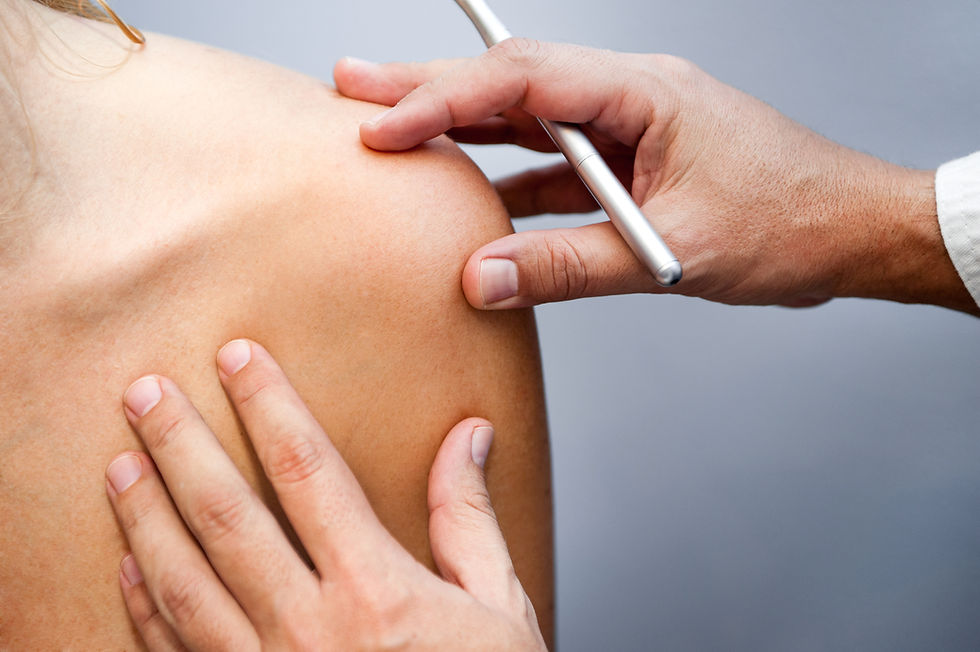
The essence of dealing with rotator cuff tears is that they only need to be fixed if they are causing a functional problem. Otherwise the pain you are getting is from the tendonitis element of the condition and not from the hole in the tendon. How do you fix the tendon back? I do what is called a mini-open repair. That means that I do the first half of the surgery as a key-hole procedure – that includes the decompression, the ACJ excision if required and a Biceps Tenotomy if required. This also allows me to accurately assess the size of the tendon tear and the quality of the tendon and to decide if it is fixable or not. The actual reattachment of the tendon back to the bone is done through a 6 – 8 cm incision on the outside of the shoulder. I divide the deltoid muscle so I can see the hole in the tendon and the bone that it was attached to. Then I roughen up that area on the bone– called the footprint – so the bone is fresh and bleeding because that gives the best environment for the tendon to bond back on to it. The tendon is released from any scarring around it and pulled back over the footprint. I use things called ‘suture anchors’ to do the reattachment. These are metal or plastic screws with sutures attached to them which I drill into the bone and then pass the sutures through the tendon and tie knots in the sutures pulling the tendon back down onto the bone. It usually requires between 2 and 5 anchors depending on the size of the tear. Then I close the wounds and put your arm in a sling. The sling might be the normal type with your arm by your side. However if there was quite a bit of tension on the repair then I may well put you in a brace sling with your arm at 45 degrees away from your body. I am afraid that is a real pain to manage but it is very important. How long do I have to be in the sling? Usually 6 weeks. Tendon has a poor blood supply (which explains why it can erode through in the first place) so it needs a good long period without any tension on it to really bond back to the bone. Can I move my arm? What I let you do depends on the size of your tear and how happy I am with the repair. So, if it’s a smallish tear with good quality, elasticy tissue that I could easily pull over the footprint without much tension, then we will get you doing passive range of motion exercises straight away. That’s where you use your good arm to move the bad one. After only 4 weeks we let you start doing active exercises – firing up the muscles in your bad arm and starting to move it under it’s own steam. And if it’s a big tear? That is a different story! The first thing is that you will be in a shoulder brace with your arm held away from your body at about 45 degrees – this is to keep any tension or pull off the repair while it heals. And the second thing is that you will be in that for 6 weeks before we get you out and start moving the shoulder. That sounds like a nightmare! It is not easy – it really isn’t. Make no bones about it because I am being truly realistic here about what you are letting yourself in for if you need to have a massive cuff tear repaired. The brace gets in the way, it is awkward to manage and can be sweaty and uncomfortable. You aren’t really selling this operation to me! Too many people are told that fixing a cuff tear is not a big deal and that they will be back to normal in a couple of months. That is just not the case. With a big tear it is a big operation and big recovery time. But remember that you presented with a shoulder that really was not much good. You couldn’t lift it up, it was no real use to you and it was painful. Those are the elements we are planning to get rid off but it is going to take you between 6 months and a year to achieve that. So you are going to go through a lot but you should gain a lot – a useful and pain-free shoulder. How long do you think the recovery time is? Be honest. For a medium sized chronic tear or any size of acute tear then you should be pretty much back to normal by 6 months. For a larger chronic tear that can take a year. Let’s take the acute tear as an example: hopefully you will just need the ordinary sling and will be in that day and night for 4 weeks but coming out regularly to do passive exercises. Between weeks 4 and 6 you can start active exercises and start to wean yourself out of the sling so that by the end of week 6 you won’t need it any more. At that point you should have reasonable to full passive movement but active movement will be lagging a long way behind. By 3 months though you should have full passive movement and a pretty good functional active range. You should have been driving a car after 8 weeks and starting to do some gentle exercises about then as well: maybe some swimming, gentle running and perhaps hitting a few golf-balls with a half-swing . After 3 months you start building up strength, stamina and resistance in the shoulder muscles and do more physical activities: weights in the gym (guided by your physio!!); playing some tennis and playing 9 holes of golf for example. At the 6 month mark I would expect you to be 80 to 90% back to normal and happy that you had the operation and that you can see just how well you have done and that normality is not too far away. And what is the timescale for the massive chronic tear? Double that? Yes – just about. It is long and it is slow but it is worth it. What happens if you can’t fix my tendon? Remember the basic ethos here – I will only fix your tendon if it is a functional problem to you. There are a lot of massive tears that don’t need to be fixed even if they could be because functional weakness or lack of movement is not the issue. And even if there is weakness using the arm over head height, a lot of my older patients are happy to adapt around that if I can do something to get rid of their pain: steroid injections, a decompression or a biceps tenotomy. However there are a group of patients who have what we call ‘massive irreparable cuff tears’ and have an associated loss of function that makes that arm pretty useless. These are the poor souls who can’t lift their hand to their face or head and are really struggling to manage. What can you do for them? Well we know the tendon can’t be repaired because the hole is too big, the tendon has retracted back too far and the muscle has wasted away. Often times too the humeral head is no longer sitting centrally on the glenoid so the joint has become eccentric and that can’t be sorted out with a cuff repair. In this situation I offer a Reverse Geometry Shoulder Replacement and if you go to the section on Cuff Tear Arthropathy you can find out all about that. The rotator cuff tendons wear through as we get older –that is just what happens so many people will have a tear without even knowing about it. The corollary of that is just because you someone finds a tear it may well NOT be the cause of your pain and therefore does not need to be repaired. I will only put you through a cuff repair if you have a functional problem directly related to it.

Tendonitis (ASD/ACJ)
Hopefully, if you read through this whole section, all your questions will be answered. Your shoulder pain has come back again after a lovely 3 or 4 weeks or longer when it seemed to have been back to normal after the injection. You had been doing everything you wanted including getting a good night’s sleep but now it actually feels quite a bit worse than before which it sometimes appears to do because it tends to go from pain-free to painful very quickly when it comes back. Time for the operation? Yes. Time for the operation and to give you back a pain-free and fully functional shoulder on a permanent basis. But if the injection didn’t ‘cure’ it, why will the operation? Good question. And the answer is in the statistics and my experience. There is a very good link between doing well with the injection – even if only for a few days – and doing very well with the operation. What I do is take the pressure off the damaged tendon so that it can run smoothly without catching and rubbing and causing pain so it can’t really come back. What does the operation involve then? Usually we can do the procedure as a day-case so you are in and out in half a day and can sleep in your own bed. It is an arthroscopic or ‘key-hole’ procedure so there are only 2 or 3 small incisions about 1 cm or less long. Let me walk you through the whole experience. You will arrive at the hospital either bright and early (usually about 0700) if it is a morning operating list or about 1230 if it is for an afternoon list. You will be shown up to your room and the nursing staff will get you settled in and go through the admission process – checking who you are; asking quite a lot of questions; doing your blood pressure; putting a name bracelet on and answering any of your questions that they can. The anaesthetist and I will come and talk to you. I will go through the consent form with you which details what I am going to do; what the benefits are going to be and what the complications could be. And then I will do the most important thing of the day which is to put a big arrow on the arm we are going to operate on with an indelible marker pen. I know it looks a bit silly but believe me this is one of the most important things I do! You will get in to the classic operating gown (tied up tight at the back!) and there will be compression stockings on your legs to minimise the chance of developing a deep vein thrombosis. (see complications) When your turn comes you will be walked down to the operating theatre by a nurse and onto a trolley in the anaesthetic room. This is where the anaesthetic team will do their bit and put you off to sleep. Now, shoulder surgery can be quite painful afterwards so an important element of the whole anaesthetic process is a special injection into the base of the neck/shoulder which puts your arm completely to sleep called an Inter-Scalene Block. (see Inter-Scalene Block) Do I have to have a general anaesthetic? Unless there is a really good medical reason then yes you do. But please don’t associate it with general anaesthetics you may have had for bigger operations or that you have had years ago. The vast majority of people wake up very quickly and without any sickness and are sitting there twiddling their thumbs and wanting to go home. The general anaesthetic (GA) makes both our lives a lot easier. We can control your blood pressure more easily which means I can do your operation more quickly and you won’t be fidgeting and moving about on the operating table making things more difficult. And the incisions? As I said above there will be between 2 and 4 small incisions each less than 1cm long. Stitches? When do they come out? Yes – one stitch in each hole. They aren’t dissolvable stitches so need to be taken out about 10 days after the surgery either back at the hospital or at your GP surgery. That will be organized before you go home. What do you actually do? One of the main problems causing tendonitis is a lack of space under the acromion (the bone on top of the shoulder) so that the tendon catches and rubs when you move your shoulder around. What I do is make a bigger space by shaving away some of that bone. Is that the spur my therapist mentioned? Yes it can be and quite a lot of patients I operate on do have a spur or a hook or an exaggerated curved shape to that part so there is naturally less space than is ideal. In some people the bone shape is normal but poor posture and the way you move the shoulder artificially narrow that space. Before I do any operating I check that your shoulder hasn’t stiffened up – that you aren’t developing a Frozen Shoulder (see Frozen Shoulder) as sometimes happens. And if you have then I change tack and deal with that instead. I start off looking into the main ball and socket joint (gleno-humeral joint) to check that for any arthritis; eroded or torn tendons; inflammation in the biceps tendon or damage to the labrum – all of which may need to be dealt with. In the older patient the long-head of the biceps tendon frequently gets caught up inside the shoulder when the arm goes up in the air and I do a biceps tenotomy. (see biceps tenotomy) Then I move to where the problem is – the sub-acromial space. This is the virtual gap between the top surface of the rotator cuff tendon and the under surface of the acromion where the tendon is rubbing or ‘impinging’. Firstly I remove the inflamed soft tissue or bursa so that I can see the bone and tendon clearly. Once that has been done I use a powered burr to shave away bone to create that increased space. If your Acromio-Clavicular joint is part of the problem then I go on to excise the end few millimeters of the collar-bone (see ACJ problems) Then the stitches, dressings and sling. You wake up quickly in the recovery area and then are wheeled back up to your room. The physiotherapist will come and see you later to show you some basic exercises to get the arm moving and I come up and see you later to tell you how it all went. Do I get any pictures of the operation? Better than that – you get a CD of the whole thing! Don’t worry – it isn’t you on the operating table. It’s the inside of your shoulder showing all the nooks and crannies and everything that I do. How long do I need the sling for? Just till your arm comes back to life and you can move it yourself. So maybe a day or two. I heard something about a nappy on the shoulder? What is that about? I do use a nappy as a dressing over the top of the sticky plasters covering the stitches. It does look a bit odd but it’s the perfect shape for the shoulder and just stops any fluid or blood oozing out. It is taken off before you go home though. Will my shoulder hurt? It shouldn’t hurt for the first 15 to 20 hours because of the Inter-Scalene Block (the injection given to the base of your neck). We send you home with pain-killers and you should start taking those when you feel the pain starting to kick in. Don’t wait until it is genuinely painful because it is much easier to keep it under control if you don’t let it take control first. You will need painkillers and anti-inflammatories regularly for about 2 weeks and then on an ad hoc basis afterwards. I have seen friends in a lot of pain afterwards and some with no pain. Why? You are right and it can be very variable afterwards with some people pretty much back to normal after a week and others still in pain after a few weeks. And I just don’t know why. What can I do and what shouldn’t I do? The important thing to remember is that, although it has been done through small holes, this is not a small operation. I have been shaving away bone and raw bone surfaces take 8 to 10 weeks to heal up and seal over. So it’s not like a knee key-hole procedure where the surgeon is removing cartilage and the recovery is much quicker. So don’t rush it. Driving a car: if it is your right shoulder you can usually drive more quickly and with an automatic that may be after just a few days. With the left and gears it can be up to 2 weeks. But try it and see as it is very variable. Showering: straight away really – or as soon as your arm has come back to life. Don’t worry too much about getting the stitches wet. The best thing is to put a waterproof plaster over each stitch while showering or bathing but do take those off afterwards and replace them with a breathable plaster otherwise the skin can get macerated. After 4 days you are actually water-proof anyway so don’t need to cover the stitches unless you want to but don’t soak them in a bath. Day to day stuff: again once your arm comes back to life you should be able to dress, wash, brush your teeth and shave but it can be a struggle to do your hair for a fortnight or so. Work: this really does depend on what you do and whether they can manage without you for a bit and the financial pressure on you. If it’s your own business and you sit behind a desk then you could be back at work the next day – if you can get there. For most office jobs a week or two is probably enough and a lot of people will work from home on a computer. For more physical things then it can be 6 weeks before you will be much use especially if this involves repeated lifting or use at and above shoulder height. However I know a lot of self-employed peopled doing physical jobs feel they have to go back to work after 2 weeks and they do manage albeit it can be pretty tough going. Sports: I suggest a gentle return to golf, tennis, swimming and the gym after 6 weeks. For golf get up to the range and just hit a dozen balls with a 9 iron and a half swing; go and have a drink and go home. Much the same for tennis. Go and knock up with a few friends just playing gentle forehands and backhands. Don’t be tempted to do too much too soon. The most important thing is to use that initial period to work with the physiotherapist on strengthening and stabilizing the shoulder rather than being tempted to get back to doing everything you were doing before. Getting those fundamentals of posture, scapular stabilization and rotator cuff strength sorted out are absolutely vital. And remember to build things back up slowly and gently over time. Often its what you were doing in your sport that has caused the problem so take the opportunity to revise your style, grip, stroke, swing etc to avoid it happening again. But you have been through a lot by having the operation and the reason for doing that is to allow you to get back to doing all the things you want to do. So after 6 weeks go and try things. But do start gently and build up slowly. Sleeping: it can take quite a while before you can sleep through the night on that shoulder but, again, it is very variable. If I have to remove your ACJ then this can be one of the last things to get back and it could be 4 months or so. Hoovering and ironing: you won’t even be thinking about this for the first 2 weeks and when you start just do one room a day and only iron a few things. Always stop before your shoulder becomes uncomfortable. How long before I am back to normal? The first 2 weeks can be quite sore; by 6 weeks you should be thinking that it was worth doing and you can see the improvement week by week; it takes 3 months to hit the 80 – 90% mark at which point you are doing pretty much everything but the final little bit can take another 3 months to achieve. But remember – you are not an invalid and you can build your activities up bit by bit after 6 weeks.

Tennis Elbow Release
I do operate on patients with Tennis/Golfers Elbow when all other measures have failed or if the patient is impatient! The procedure is done as a day-case and under general anaesthetic and takes about 20 minutes or so to complete. I make an incision about 3 cms long over the point of the outside of the elbow (Tennis Elbow) or inside of the elbow (Golfers Elbow). As discussed in the section on Tennis Elbow, there are two problems causing Tennis Elbow: the tendon is under too much tension and it has degenerated. In order to allow it to regenerate that tension needs to be released. So what I do is carefully release the tendon from the bone and as it peels off you can see it being pulled down the forearm as the tension is relaxed. It will often move between 0.5 and 1 cm. Then I lightly tack the end of the tendon into it’s new resting place and stitch the skin closed. The stitches are under the skin so don’t need to be removed. And there will be paper stitches over that and then a dressing. You will be in a sling for about a week but can use your hand gently straight away. Once out of the sling you will start gently using the elbow and regain full movmement over the next 10 days or so. You should avoid doing any heavy work or gripping for the first few weeks and the physio will guide you through a rehabilitation programme until you are back to normal. You can usually drive after 10 days (more quickly with an automatic obviously) but a return to physical work and gripping activities should be held off till 6 weeks. Many people feel their elbow is much better after 2 weeks but in some it can be the full 6 weeks before they recover.

Ulna Nerve Transposition
The tingling in the outside of your hand is getting worse and the NCS tests have proved that it is because the nerve is being compressed at the elbow. The way to deal with that is by surgery. So what happens? The operation is done as a day-case and under a general anaesthetic. Yes – you do need a general aneasthetic. I am operating on a nerve and it would not be good if you were to start twitching and moving around at the wrong moment. So off to sleep you go! Where is the scar and how big will it be? The scar is on the inside of the elbow and runs along the course of the nerve for 6 – 8 cms. You can usually feel the nerve yourself in its groove between the bony lump on the inside of the elbow and the bony point of the elbow. The scar will be in a pretty hidden position so really won’t be easy to see. How do you unsqueeze the nerve? The nerve runs in a groove between those two bony prominences but just before it turns the corner and just after, it is held in place by tunnels or arches of fibrous tissue. And this is usually where it gets squeezed. So what I do is release the nerve from where it normally runs and make those tunnels bigger so there is no squeeze on it any more. But if I just left it in the same place you could get problems again because remember, one of the issues is the nerve getting tight when the elbow is bent. The next step therefore is to move the nerve (transpose it) so it can take a shortened route around the elbow. That means when you bend the elbow the nerve doesn’t get stretched. So I gently move it in front of the bony lump and create a little sling of tissue to hold it there. Any stitches? Do I need a sling? The stitches are dissolvable ones under the skin so you don’t need to worry about those. You do need a sling for about a week. This is just to allow everything to calm down and start to heal. You can turn the hand and wrist round and move the elbow up and down a little bit (maybe 30 degrees or so) to try and stop it stiffening up too much. There is a padded bandage around the elbow that you take off after 4 days and there will be a waterproof dressing over the scar so you can then shower and bath. After a week you can get rid of the sling and start using the arm as normal. Will the tingling go straight away? In many people it does but the nerve has a memory so, even when the squeeze is taken off it, it can still think it is being compressed for up to 6 weeks. Sometimes longer if the symptoms have been very severe or you have had them for a long time. So when can I drive? As soon as you are out of the sling (a week!) AND confident that you have enough movement and function in the elbow you to control a car. And using the arm for work and sports? Pretty quickly. You could probably use a keyboard even while in the sling so that, if your job allows it, you could work from home or even from your desk if you really had to go straight back. For a more physical job, and for most sports, you should be pretty good after 2 weeks and fine after 4. Does it always work? No, it does not have a 100% success rate. The two main problems are that your body can over-react and produce a lot of scar tissue around the nerve and, from time to time, I have had to go back and re-release the nerve. And sometimes the compression has just been too much or gone on for too long and the nerve has been permanently damaged.

Wearing Your Sling
If I have put you in a sling after your operation then it was for a very good reason and not just for show. So if you want the best result from the procedure – wear it! I know it can be, literally, a pain in the neck so, in virtually every case, I am happy for you to take the sling off when you are seated and safe. Get a cushion or pillow and put it on your knees. Then gently remove your arm from the sling and rest the forearm on the pillow. This takes the stress off your neck and allows your shoulder to drop back into a more natural, relaxed position. Just remember to put it back on again when you get up! And yes you do have to wear it at night. I do see patients with the straps and velcro bits all over the place. These next pictures show you how it should be worn.
Wound Care
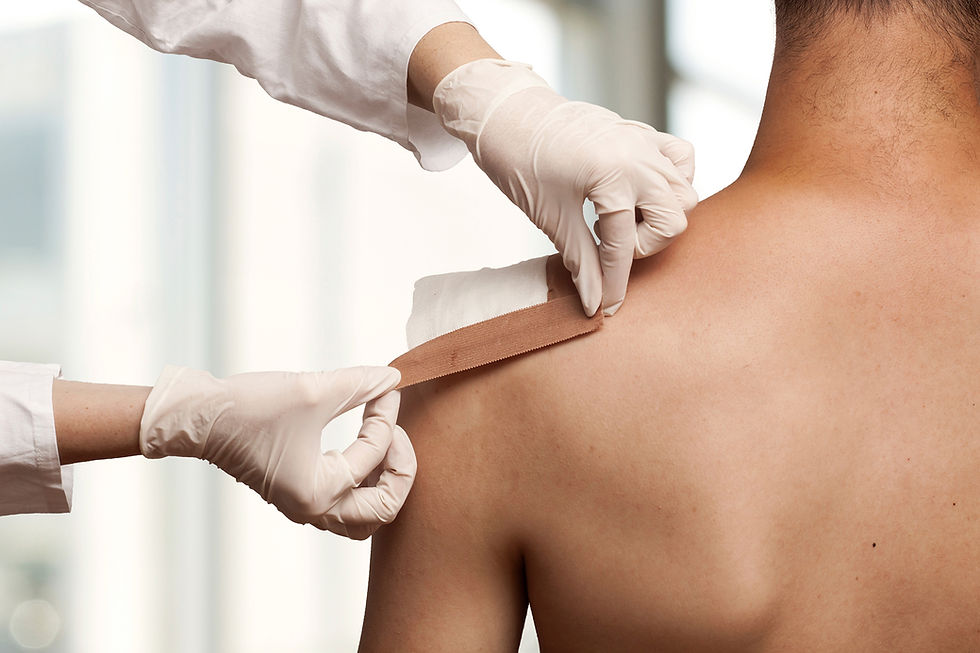
Most of the operations I do are arthroscopic or keyhole procedures that are done through small incisions less than 1 cm long. These are closed with a non-absorbable suture i.e. a stitch that has to taken out because it does not dissolve by itself. They need to come out about 10 days after the surgery. That isn’t an absolute date and it is better to take them out earlier rather than later. Private patients usually have this done back at the hospital where they had their surgery and that appointment will be organised for you before you are discharged. NHS patients usually have their stitches taken out back at their GP’s surgery and the patient needs to organise that themselves. Before you are discharged the nurses will remove the nappy (yes – I do use a nappy as an absorbent dressing on top of the shoulder and over the stitch dressings) and put clean dressings over the wounds. For baths and showers you should put a waterproof ‘Elastoplast’ over each of the stitches (between 2 and 4 usually) but, once you have dried off, remove the waterproof plaster and replace it with a breathable one. The reason for that is that if you leave the waterproof one on, the skin can become soft and macerated. After 4 or 5 days you are actually waterproof and don’t really need to keep the stitches covered at all unless you want to. But don’t rub at them or soak them in a bath. The same goes for larger wounds that are either closed with metal clips (taken out at 10 days) or closed with sub-cuticular stitches (dissolving stitches under the skin that don’t need to be taken out). You should keep a dressing over them for the same 4 to 5 days. Virtually always the arthroscopic wounds will heal up very rapidly and with no problems at all. Occasionally there may be a bit of redness and swelling around the wound. This is not an infection – just inflammation – and will settle when the stitch comes out. You should use complete sun block on the wounds for the first year after your surgery as exposure to sunlight can irritate and inflame it. Arthroscopic wounds virtually disappear after 6 months. You will barely know they were there.