Shoulder - Elbow - Hand
By Richard Sinnerton - Everything you need to know about the upper limb and were afraid to ask

Other Treatments
Treatments

Posture
Sit up straight! You know what you SHOULD do when you are at your desk but I do appreciate how difficult it can be to actually do it! However that slouched posture will have contributed to your shoulder pain (and probably your neck pain and back pain as well) and there is only one person who can eliminate bad posture from the equation. Addressing postural problems is very important if you have a painful shoulder and it could be that rehabilitation therapy and improving the way you sit at your desk might be all that’s needed to get rid of the pain so avoiding an injection or an operation. And if you do need an injection and your pain goes, don’t be complacent. You should use that pain free window to work on preventing a recurrence and sorting out your posture is a big part of that. If it comes to surgery you will still need to learn to sit up straight because I will have created more space for your tendon to run in without rubbing. But if you still slump and have a round-shouldered posture then that new space will quickly get closed down and your pain will come back. So how should you sit? Up straight. It is as easy as that. You should have your head over your shoulders and your shoulders over your hips. You don’t need an expensive chair and there is no such thing as an ‘orthopaedic chair’ – that is just marketing spiel and means nothing. When I do clinics in the City I see people in chairs costing hundreds if not thousands of pounds. But if you still slouch in it, it isn’t doing you any good. You need a chair that allows you to slide in so that your tummy is almost up against the edge I your desk. So that means either no armrests or adjustable downwards arm-rests or elbow pads only. Your chair should be high enough that, with your elbows at your sides, your forearms are angling down slightly sobthey your hands rest on the keyboard. I don’t advise using wrist supports. But it is often the mouse that causes the most problems. When I ask people to demonstrate their mouse position they almost always shove their arm out and away from their body. Wrong. Keep your elbows glued to your sides. That is the absolute key. Elbows glued to sides. If you do that you sort of automatically come up into a better more upright position. Okay you may not be able to hold it for very long but it feels pretty good for a few minutes. Try it and see? Straight back and elbows to the sides. Now from that position (elbow locked to the side) you can manipulate the mouse and get to every part of your screen without moving the shoulder at all. And that is where you need to be. The more you do it the longer you will be able to hold that position for. And a lot of ache and pains will go. If you watch Mad Men you will get the picture. Set in the 60s the secretaries sat up straight with their elbows by their sides and even with the big heavy keys on an old fashioned IBM typewriter there was no RSI or neck pain or shoulder pain.

Steroid Injections
Steroids do have a bad name and quite rightly so if they are misused and you will all have heard about steroid abuse in athletes and body-builders for example. I am more concerned about a different sort of abuse – where doctors treat painful shoulders with injection after injection after injection failing to realise or accept that there is a structural issue and that surgery may actually be the right thing to offer. Sadly I’m afraid this comes down to a little bit of professional rivalry but thankfully I see the situation where a patient only gets to me after 8 or more injections less and less frequently. Won’t the injection just mask the symptoms not cure them? It may do and you may have a pain-free shoulder just for a few weeks. But that’s when the important next decision needs to be made. If the steroid hasn’t cured your shoulder then there is probably very little point in repeating the injection because the chances are that the same thing will happen – good for a few weeks then painful again. So you only do one injection? Someone said you should only have 3. I generally only do one injection and if that does the trick i.e. you are pain free and doing all your sports and activities with no recurrence of the pain after about 6 weeks or so, then I would consider you cured. I usually recommend therapy during that pain-free window to help get rid of any bad habits in the way you use your shoulder as well. Then what? Then an operation. Usually I do a steroid injection for tendonitis/Impingement/Rotator Cuff Syndrome and will have done x-rays or a scan to get an idea of the structural state of your shoulder and if there are spurs or hooks on the acromion or calcific deposits in the tendon or arthritis in the AC joint then an operation should be considered. My shoulder was only pain-free for a week though. Mind you it was lovely for that week and I really though you had cracked it. If that injection didn’t work why would an operation? Actually I would say that injection did work. Okay it didn’t work for very long but you were back to normal if only for a week and that tells me that your shoulder is definitely cureable and that I can get the same result on a permanent basis with surgery. I can’t take the time off for an operation now. Could I have another injection to get me through till I can? That is a reasonable request and something I do do quite frequently. If you had a good 6 weeks or so after the first injection but now it is painful again and the timing is not right for surgery then I can buy you a bit more time with a second injection. My GP did an injection but it made no difference and I’m not keen on another one. That is understandable but, at the risk of upsetting all my GP colleagues, they aren’t always doing the injection the best way. Remember I do shoulder injections many times a week whereas the GP will be doing them only occasionally. Many of them also still use a rather out-dated technique which we now know isn’t so effective. So I tend to ignore a failed injection from a GP and start afresh. This is my first steroid injection. Is it going to hurt? I am afraid so because it is a needle but, usually, it is not a big deal and frequently what patients say is “was that it?”. That isn’t always the case though and it can be painful at the time. Can I use my arm afterwards? Straight afterwards things are often fine and, indeed, you may find that the pain goes away instantly because of the local anaesthetic I use. So you can drive home from the clinic and do normal things with your arm. In about 25% of cases the shoulder can be a lot more painful the next day and can be bad for a few days. You just need to take pain-killers and grin and bear it because it will pass and then, hopefully, you will find that your shoulder pain has settled. When I can I get back to sports? Always remember that it is often your sport that has contributed towards your pain – especially overhead activities like tennis and swimming and weights in the gym. So, if the injection gets you pain free do not rush back into those activities but use the pain-free window to work with a therapist to regain control of the shoulder, get rid of any bad habits and work on strengthening the important muscle groups before venturing back to sports. Why are you injecting the back of my shoulder when all the pain is in the front? In fact, why are you injecting my shoulder at all when all the pain is down my arm? The pain you get in your arm is called “referred pain” and is actually generated in the shoulder but appears in the front or side of the upper arm. Before I do the injection I will have put your shoulder through a series of manoeuvres and tests and that should have demonstrated to you that moving the shoulder causes the pain down the arm. And the reason I inject through the back is that it gives the best access to the whole sub-acromial space – the area above the rotator cuff and below the bone that the tendon has been rubbing on. It’s the same place I put the arthroscopic camera into your shoulder if it comes to surgery, so I know the needle is in the right place. And what exactly do you inject? I use a mixture of 0.5% Chirocaine which is a local anaesthetic that has two roles. It helps to numb the shoulder (which explains why sometimes your pain can go pretty much straight away) and it increases the volume of the injection to 10mls which helps spread the steroid across the whole of the tendon area. The steroid I use is called Depomedrone and I use 80 mg. That is only 2mls in volume and given by itself could just disappear into the fat or other tissues unless it is absolutely in the exact spot and that’s why I add the local anaesthetic – to get a bigger volume which is much more effective. I am on Warfarin so can’t have an injection. Well, actually you can and I don’t worry about the blood thinners unless your control is very poor. I am massively needle phobic and there is no way I am having an injection. You are not alone and what I can do is admit you to the hospital for half a day; get you down to theatre where the anaesthetist can sedate you (without using a needle!) and then I can do the injection without you knowing anything about it. So don’t worry about that. Many people do have worries about a steroid injection: perhaps because they have heard bad things about them; or don’t think they can be a cure; or don’t want ‘artificial’ products in their system; or have had one before that made no difference. I hope I have shown that these worries are not based on the actual facts and really their only worry is if someone is treating them with multiple injections. An injection does hurt (a bit) but as you must have been in pain anyway if you have come to see me, that would seem a small price to pay for a treatment that, much more often that not, will make you better and may be all you need to get back to normal.

Help with phobias
Several times a week I encounter patients who have phobias which have a direct effect on how I can best treat them. The most common are people who have needle phobia. This means that instead of being able to help them straight away by doing an injection in the clinic, they have to wait to be admitted and have the injection done with them sedated/anaesthetised. The next group are thse who have claustrophobia and cannot manage to get into an MRI or CT scanner. This means a very important tool for investigating their problem can’t be used and I have to use an alternative imaging modality which may not be as accurate. Although the instinct of the Orthopaedic Surgeon is to say “pull your sock-ups” we do realise that that is a strategy that really doesn’t work. But what does work? There is a wonderful technique called Neuro Linguistic Programming (NLP) which can work wonders in getting you over these sort of phobias. It doesn’t involve years of therapy or psycho-analysis but is a very effective and quick-acting way of getting you over these fears. The guru of this technique is Richard Brandler – a rather brash Texan! – but it really works.

Therapists
Physiotherapists, Osteopaths and Chiropractors Most shoulder problems do not need surgery in order to get better. Many will resolve with time and can be helped on the way by simple actions such as avoiding whatever caused the pain in the first place, working on improving strength and control in the muscles around the shoulder and addressing the postural issues which plague our modern lifestyle. This means that you don’t always need to see me and that treatment from a good therapist is often the most effective way of getting you pain free and back doing all the things you want to do. And just because you do end up being referred to me does not mean that you need an operation. I get sent patients who need different approaches in their recovery. Some just need to know that nothing serious is amiss and then they are happy to put up with their aches and discomfort. Some have a condition such as Frozen Shoulder where surgery is an option but perhaps 50% will choose to wait it out knowing it will improve eventually. Many can be helped by a steroid or hydrodistension injection that gets them pain free and allows their therapist to work on their rehabilitation rather than just fighting their pain. And of course there are those where surgery is either the first line of treatment or where therapy and injections have only given temporary relief. Therapy is extremely important for patients with shoulder problems and therapists are very important for shoulder surgeons in order to get the best possible results for the patients on whom they end up operating. It is often quoted that the operation is only half the battle and that good quality rehabilitation is the other half i.e. neither surgery or therapy by themselves will do the trick and they need to be combined. The key though is the ‘good quality’ bit and one of the biggest problems I face is the number of patients who have wasted months and hundreds of pounds on therapy that is really not up to scratch. What I dread hearing is that a patient has been sat in a room with a heat lamp on their shoulder or has had 20 minutes of ultra-sound or some such nonsense in an effort to treat their unstable shoulder. That is just not acceptable and does nothing for the patient and gives the whole therapist profession a bad name. In the same way as a surgeon who wants to operate on every painful shoulder gives our profession a bad name. So, if you have had therapy I will always ask what they have been doing and you will probably be able to tell from my face whether I think they have been wasting your time. And when I send you for therapy it will be to someone who I know and who has worked successfully on my patients in the past – whether that is a physiotherapist an osteopath or a chiropractor. They will all keep their black boxes locked away and will work in a hands-on fashion with you re-educating your brain to hold your muscles in the right position and teaching them how to work in the right patterns to hold and move the shoulder and shoulder blade properly. This can be very, very successful and, combined with a steroid injection, is the first line of treatment for most shoulder problems. A good therapist will be perfectly happy to see someone who’s shoulder is no longer painful after a steroid injection because they have a better opportunity, faced with a pain-free patient, to look at why that shoulder became painful in the first place and maximise the function in it to minimise the chance of any recurrence. So if a therapist asks why you are here (after an injection has taken the pain away) and everything is ok so you don’t need therapy then walk away because you don’t need therapy from them – you need therapy from someone who understands that you do need help to prevent the pain coming back; to iron out the bad habits in your shoulder and get it strong and moving properly again. Over the years I have built up an excellent relationship with the therapists I respect and who, in return, think I am doing a good job. Remember we both have choices and they won’t send you to see me if they don’t think my results are good and vice versa. Therapy – good quality therapy, using the right techniques for the right indications on the right patient – is an essential, and often the main, part in getting your shoulder better. And, as a surgeon, that is quite hard to admit!

Alternative Therapies
There are many different facets that need to come together in order for you to recover from a shoulder, elbow or hand problem. The fact is that only about 10% of the people referred to me actually need an operation and even after that help is needed from physical therapists. It is vital to have the right mental attitude too. If you don’t think you will get better, or don’t want to get better, then your pain will always be with you. There are many, many allied therapies of varying degrees of acceptance by the mainstream. Osteopathy and Chiropractic treatment I would now consider main stream (although that is very user dependent!). There are an increasing number of clinics which combine Physiotherapists, Osteopaths and Chiropractors under the same roof and in the same team. They appreciate that one size doesn’t always fit all and by combining different modalities then their results improve. As we move a little more left-field the next treatmemt we encounter is Acupunture. Now, you might expect me, as a surgeon, to rather pooh-pooh this but it does seem to work and I have lots of patients who’s pain synptoms have been relieved with Acupuncture. However everything beyond that has no statistical evidence or scientific background in its support. If it makes you feel better then fine but that is an emotional improvement and not a physical one. So, homeopathy, auras, hot stones etc etc etc are all…..nonsense. If it helps you then that is fine but do not expect me to advocate, recommend or prescribe any of these sort of treatments!

Complications
All operations carry risks. Thankfully, in routine surgery on the shoulder and elbow, those risks are extremely rare. I do have to discuss them with you however, so that if you decide to have an operation you not only know the reasons why I am doing the procedure and the potential benefits of it, but also the possible downside. This is called ‘informed consent’. It can be a bit daunting to be told all the things that can go wrong just before you get taken down to theatre for your surgery and, although some people tell me they don’t want to know, I’m afraid to say that it is a legal requirement that you are informed. Infection. I think what patients worry about the most is the risk of infection especially with all the horror stories in the press about ‘superbugs’ and MRSA. The benefits of routine surgery and of that surgery being carried out in a private hospital, is that the risk of infection is negligible. As far as I am aware I have never had an infection in an arthroscopic (keyhole) procedure done on one of my patients. There have been a few superficial infections in the incisions but those are not serious and a few days of antibiotics will settle that down. Infections do occur in operations done through larger incisions and we take every precaution to keep that risk at an absolute minimum: clean rooms; sterile theatres and equipment and using modern antibiotics where indicated. Deep Vein Thrombosis. There is very small but genuine risk of Deep Vein Thrombosis or DVT. This is the clot in the calf that you may hear about especially in people flying long haul and it is an issue because part of the blood clot can break off and move through the blood vessels before getting clogged in the lung and causing sudden death – a Pulmonary Embolism. The way to minimise that risk is to find out if you have any pre-disposition to it or any factors in your life-style that could contribute to a DVT forming. We evaluate this in the medical pre-screening assessment and there are guidelines that we use to grade your risk and take suitable precautions. Virtually always you will wear compression stockings to stop the clot forming and if we consider your risk to be higher than normal then we may give you a shot of a blood thinner. Whilst you are on the operating table there are special pumps attached to your calves which keep the blood pumping round. Frozen Shoulder. The most common but, thankfully, least serious complication is getting a frozen shoulder. This is where the shoulder sort of over-reacts to the trauma of the operation and freezes up. It doesn’t happen instantly. Often everything seems to be going according to plan and it is only at about the 6 week mark when your progress halts and the shoulder becomes stiffer and more painful. It freezes up. The important thing is to recognise and be aware of this as a potential problem because otherwise you and your therapist may continue banging away and pushing the shoulder even though you are aware things are no longer going as planned and it is getting more and more painful to move the shoulder less and less. So just be aware of it. A great start and then a slow down and a stiffer shoulder? You might be freezing up. Come back and see me if you are worried and we can see if that is the problem. Nerve damage and CRPS. There are a couple of rare complications that you may have worries about. There are reported cases of nerve damage after shoulder surgery either because the shoulder is suddenly moving a lot more so the nerve gets stretched or it gets bruised and bashed during the operation or it can be damaged by the Anaesthetist when inserting the needle to do the Inter Scalene Block (ISB). The statistics are that about 1:5000 cases there will be temporary nerve damage – some weakness or some pins and needles – and 1:15000 times that can be permanent. To put that in perspective it is about the same risk as being killed in a car crash. In 15 years of doing shoulder surgery 3 of my patients have had serious nerve injuries (2 from the ISB and 1 from the nerve being pulled during the release of a frozen shoulder). All 3 recovered but 2 did need surgery to get better. So this is a serious, but thankfully rare complication, and when it has occurred the patients have recovered. The other rare complication is a condition called Chronic Regional Pain Syndrome. This is where the whole arm over-reacts to the trauma of the surgery and becomes chronically painful with swelling in the fingers and stiffness. This is a nightmare and I am typing this with fingers crossed because I don’t think I have ever had a patient who had this. Please don’t worry. What you must always remember is that virtually all the operations I do on shoulders and elbows are not essential. You may here me say that ‘you haven’t got cancer and your shoulder pain isn’t going to kill you but surgery could’. I know that sounds a bit drastic but it’s true and sometimes the risks of the complications do outweigh the benefits of successful surgery and we decide that an operation is not in your best interests. I am sure that in those circumstances both you and your loved ones would rather have you alive with a bad shoulder than dead with a good one! But lets not panic. In many years of doing routine shoulder surgery none of my patients has died and, as far as I know, no keyhole operation had ever had an infection.

Ulna Nerve Transposition
The tingling in the outside of your hand is getting worse and the NCS tests have proved that it is because the nerve is being compressed at the elbow. The way to deal with that is by surgery. So what happens? The operation is done as a day-case and under a general anaesthetic. Yes – you do need a general aneasthetic. I am operating on a nerve and it would not be good if you were to start twitching and moving around at the wrong moment. So off to sleep you go! Where is the scar and how big will it be? The scar is on the inside of the elbow and runs along the course of the nerve for 6 – 8 cms. You can usually feel the nerve yourself in its groove between the bony lump on the inside of the elbow and the bony point of the elbow. The scar will be in a pretty hidden position so really won’t be easy to see. How do you unsqueeze the nerve? The nerve runs in a groove between those two bony prominences but just before it turns the corner and just after, it is held in place by tunnels or arches of fibrous tissue. And this is usually where it gets squeezed. So what I do is release the nerve from where it normally runs and make those tunnels bigger so there is no squeeze on it any more. But if I just left it in the same place you could get problems again because remember, one of the issues is the nerve getting tight when the elbow is bent. The next step therefore is to move the nerve (transpose it) so it can take a shortened route around the elbow. That means when you bend the elbow the nerve doesn’t get stretched. So I gently move it in front of the bony lump and create a little sling of tissue to hold it there. Any stitches? Do I need a sling? The stitches are dissolvable ones under the skin so you don’t need to worry about those. You do need a sling for about a week. This is just to allow everything to calm down and start to heal. You can turn the hand and wrist round and move the elbow up and down a little bit (maybe 30 degrees or so) to try and stop it stiffening up too much. There is a padded bandage around the elbow that you take off after 4 days and there will be a waterproof dressing over the scar so you can then shower and bath. After a week you can get rid of the sling and start using the arm as normal. Will the tingling go straight away? In many people it does but the nerve has a memory so, even when the squeeze is taken off it, it can still think it is being compressed for up to 6 weeks. Sometimes longer if the symptoms have been very severe or you have had them for a long time. So when can I drive? As soon as you are out of the sling (a week!) AND confident that you have enough movement and function in the elbow you to control a car. And using the arm for work and sports? Pretty quickly. You could probably use a keyboard even while in the sling so that, if your job allows it, you could work from home or even from your desk if you really had to go straight back. For a more physical job, and for most sports, you should be pretty good after 2 weeks and fine after 4. Does it always work? No, it does not have a 100% success rate. The two main problems are that your body can over-react and produce a lot of scar tissue around the nerve and, from time to time, I have had to go back and re-release the nerve. And sometimes the compression has just been too much or gone on for too long and the nerve has been permanently damaged.

Wearing Your Sling
If I have put you in a sling after your operation then it was for a very good reason and not just for show. So if you want the best result from the procedure – wear it! I know it can be, literally, a pain in the neck so, in virtually every case, I am happy for you to take the sling off when you are seated and safe. Get a cushion or pillow and put it on your knees. Then gently remove your arm from the sling and rest the forearm on the pillow. This takes the stress off your neck and allows your shoulder to drop back into a more natural, relaxed position. Just remember to put it back on again when you get up! And yes you do have to wear it at night. I do see patients with the straps and velcro bits all over the place. These next pictures show you how it should be worn.
Wound Care
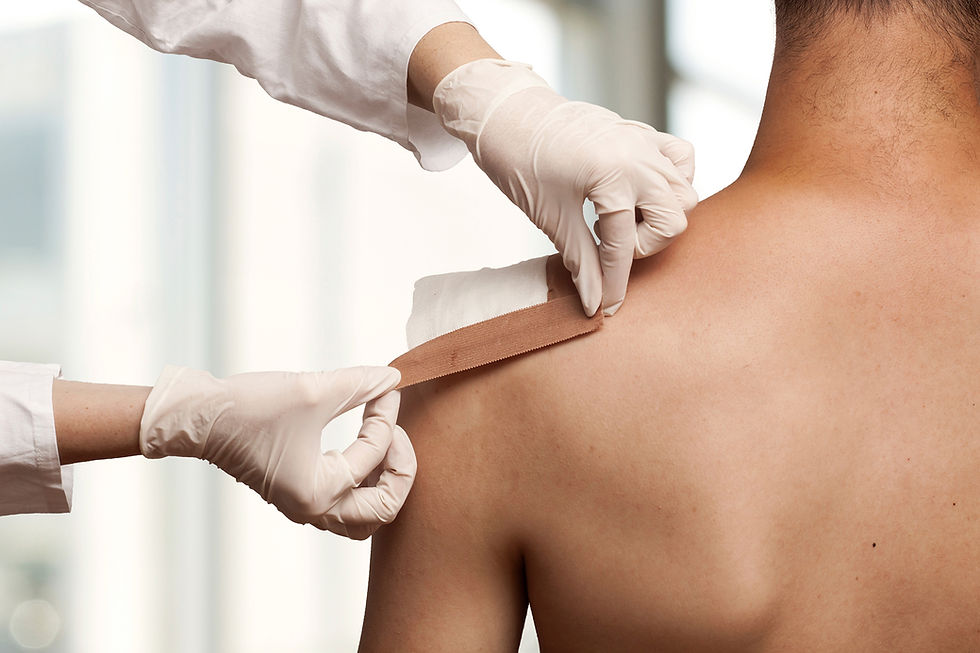
Most of the operations I do are arthroscopic or keyhole procedures that are done through small incisions less than 1 cm long. These are closed with a non-absorbable suture i.e. a stitch that has to taken out because it does not dissolve by itself. They need to come out about 10 days after the surgery. That isn’t an absolute date and it is better to take them out earlier rather than later. Private patients usually have this done back at the hospital where they had their surgery and that appointment will be organised for you before you are discharged. NHS patients usually have their stitches taken out back at their GP’s surgery and the patient needs to organise that themselves. Before you are discharged the nurses will remove the nappy (yes – I do use a nappy as an absorbent dressing on top of the shoulder and over the stitch dressings) and put clean dressings over the wounds. For baths and showers you should put a waterproof ‘Elastoplast’ over each of the stitches (between 2 and 4 usually) but, once you have dried off, remove the waterproof plaster and replace it with a breathable one. The reason for that is that if you leave the waterproof one on, the skin can become soft and macerated. After 4 or 5 days you are actually waterproof and don’t really need to keep the stitches covered at all unless you want to. But don’t rub at them or soak them in a bath. The same goes for larger wounds that are either closed with metal clips (taken out at 10 days) or closed with sub-cuticular stitches (dissolving stitches under the skin that don’t need to be taken out). You should keep a dressing over them for the same 4 to 5 days. Virtually always the arthroscopic wounds will heal up very rapidly and with no problems at all. Occasionally there may be a bit of redness and swelling around the wound. This is not an infection – just inflammation – and will settle when the stitch comes out. You should use complete sun block on the wounds for the first year after your surgery as exposure to sunlight can irritate and inflame it. Arthroscopic wounds virtually disappear after 6 months. You will barely know they were there.